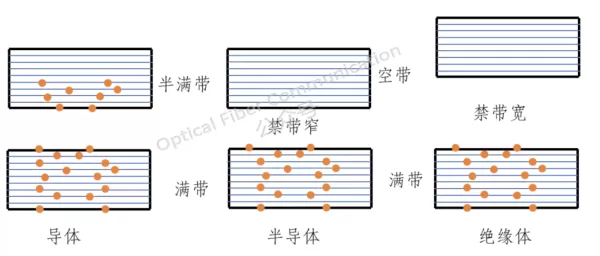
Substances in nature can be divided into conductors, semiconductors, and insulators according to their conductivity. Conductors, such as common metals, have strong conductive properties; insulators exhibit almost no conductivity; while semiconductors exhibit unique conductivity between that of conductors and insulators. This intermediate-state property makes them the core material for manufacturing electronic devices.
From the perspective of band theory, the essence of the difference in conductivity lies in the distribution of electronic energy states in the material: the half-filled band structure of a conductor allows electrons to migrate freely to form current, while semiconductors and insulators both exhibit the characteristic of a valence band (full of electrons, a filled band) completely separated from a conduction band (unfilled with electrons, an empty band).

From the band structure, insulators and semiconductors look similar. The bottom energy bands are mostly filled bands, and the electrons in the filled bands make no contribution to conduction. The upper energy bands are empty bands, which contain no electrons and therefore cannot conduct electricity. Between the filled band and the empty band lies a forbidden band. Materials with a relatively large forbidden band width are completely non-conductive and are insulators, while materials with a relatively small forbidden band width have some conductivity and are semiconductors.
However, for a more precise definition, substances are clearly divided according to their conductivity by resistivity values:
- Conductor: ρ<10⁻⁴ Ω·cm,
- Semiconductor: ρ~10⁹ Ω·cm,
- Insulator: ρ>10⁹ Ω·cm.
Elemental semiconductors are elements with semiconducting properties; there are 12 in total, including boron, silicon, and germanium. Among them, silicon is the main material in semiconductors, mainly used to manufacture various semiconductor devices and integrated circuits.

Compound semiconductors are compounds with semiconducting properties, which can be divided into binary compound semiconductors and multi-element compound semiconductors.
- III-V binary compound semiconductors such as GaAs and InP are used in high-frequency devices and satellite communications,
- II-VI binary compound semiconductors such as ZnS, CdS, and CdTe serve as photosensitive materials for solar cells,
- The IV-IV binary compound semiconductor SiC serves high-power devices with its high thermal conductivity,
- The II-VI ternary solid solution HgxCd1-xTe is used for infrared detection, and GaAs1-xPx for light-emitting diodes.
Related Reading
- 2024 Semiconductor Industry Research Report – Automotive-Grade Chips
- 2024 Global and Taiwan Semiconductor Industry Outlook
- What is a Wide-Bandgap Semiconductor?
Enjoy this article?
Subscribe to get new optical communication insights delivered to your inbox. Free, unsubscribe anytime.