Let’s first explain a concept: chirp.
In AM (amplitude modulation), we distinguish “1” and “0” by the level of the signal amplitude. Modulation in which the frequency changes over time is FM (frequency modulation).
The laser used at the very beginning was DML direct modulation, also called internal modulation. Its principle is to apply an alternating or pulsed voltage directly to the laser source to change the output light intensity.
For example, the DFB laser has exactly this structure. We use a varying current to change the “gain” and “carrier density” in the active region, making the laser rapidly switch between “bright” and “dim” states to achieve intensity modulation.
However, while changing the light intensity, the effective refractive index inside the laser also changes instantaneously, which means the optical length of the resonant cavity changes momentarily.
According to physics, this causes an instantaneous shift in the output light’s wavelength (that is, frequency). This instantaneous change in frequency is chirp.
So chirp describes the phenomenon of the signal frequency changing over time, a characterization of the pulse in the time domain. We usually describe it with the chirp coefficient α, also called the linewidth enhancement factor.
dn/dN represents the rate of change of refractive index with respect tocarrier density, the direct physical cause of chirp;
- dg/dN represents the rate of change of optical gain with respect to carrier density, the basis for achieving lasing and amplitude modulation.
Chirp causes the signal frequency to shift, and light of different frequencies travels at different speeds in the fiber. If the frequency shifts and broadens, it causes time delay.
It should be clear that chirp itself does not “produce” dispersion. Dispersion is an intrinsic physical property of the fiber; it exists regardless of whether the signal has chirp. But in the time domain, dispersion causes inter-symbol interference.
Therefore, directly modulated DFB lasers have relatively high chirp and poor tolerance to dispersion, limiting both transmission distance and rate.
But the advantage of the DFB is low cost, low power consumption, compact structure, and simple driving. It is typically used in short-distance intra-data-center interconnects, 5G fronthaul, and access networks (such as GPON).
Therefore, to minimize the impact of chirp, we no longer directly modulate the laser’s output intensity; instead, we use an external modulator after the laser output to modulate the light wave.
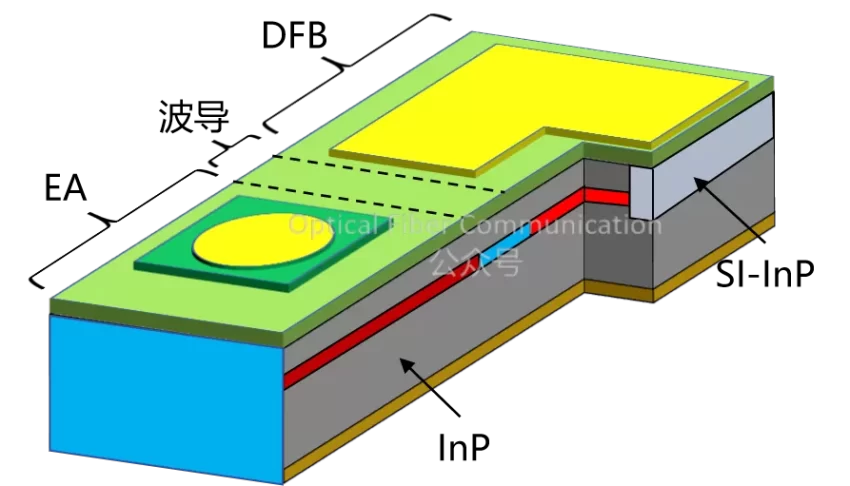
For example, the EML laser can be regarded as a DFB laser plus an EAM electro-absorption modulator. Here the DFB is only responsible for emitting continuous-wave light, while the EAM controls the on/off of the light by changing the absorption coefficient through voltage.
This process has very little impact on the optical frequency, which means the chirp introduced by the EML is extremely low.
So can the laser’s chirp be completely eliminated? Yes, it is feasible, for example by using a light source scheme that supports an MZM modulator.
It uses the push-pull operation of the MZM: we apply voltages of equal magnitude and opposite polarity to the two waveguide arms separately.
In this way, the refractive index change is converted into a pure phase difference. The phase delay of one beam and the phase advance of the other are completely symmetric.
From the perspective of the whole device’s input and output, this symmetric process introduces no net phase shift that changes over time, that is, no frequency chirp.
Finally, let’s summarize with a table:
A brief introduction, thanks for reading and supporting!
Welcome to subscribe to our column: Silicon Photonic Devices + Optical Modules + Chips. Add WeChat WaytoICT to join the Semiconductor & Optical Component Industry Chain Group 2.
Welcome to join our community and access a wealth of high-value technical documents and trend research reports in the fields of semiconductor chips, optical components, and optical modules!
If you are interested in semiconductors / optical components / optical modules / optical fiber communications
Welcome to follow us!
Related Reading