Hollow-core fiber is not a new concept; the industry has been trying for more than 20 years.
Related reading:
“Microsoft: Validation Data of 400G ZR over Hollow-Core Fiber“
Coherent: Three Coupling Schemes from Hollow-Core Fiber to Single-Mode Fiber
Corning: Nodeless Anti-Resonant Leakage-Suppressed Hollow-Core Fiber
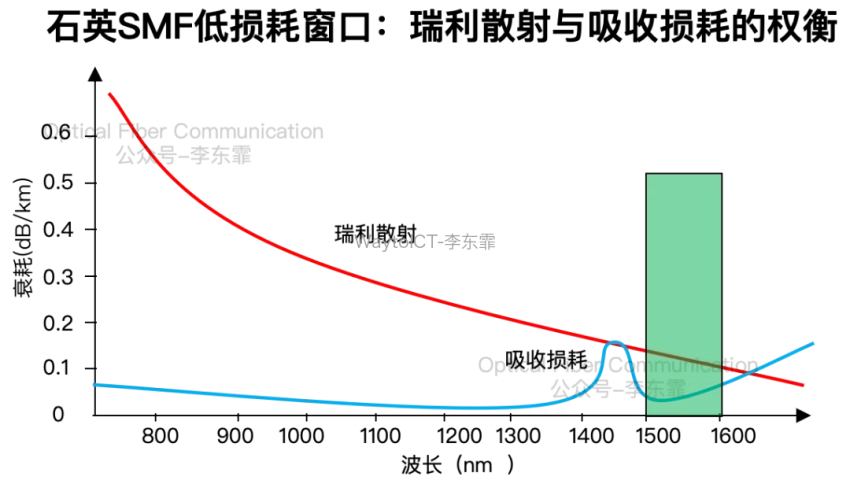
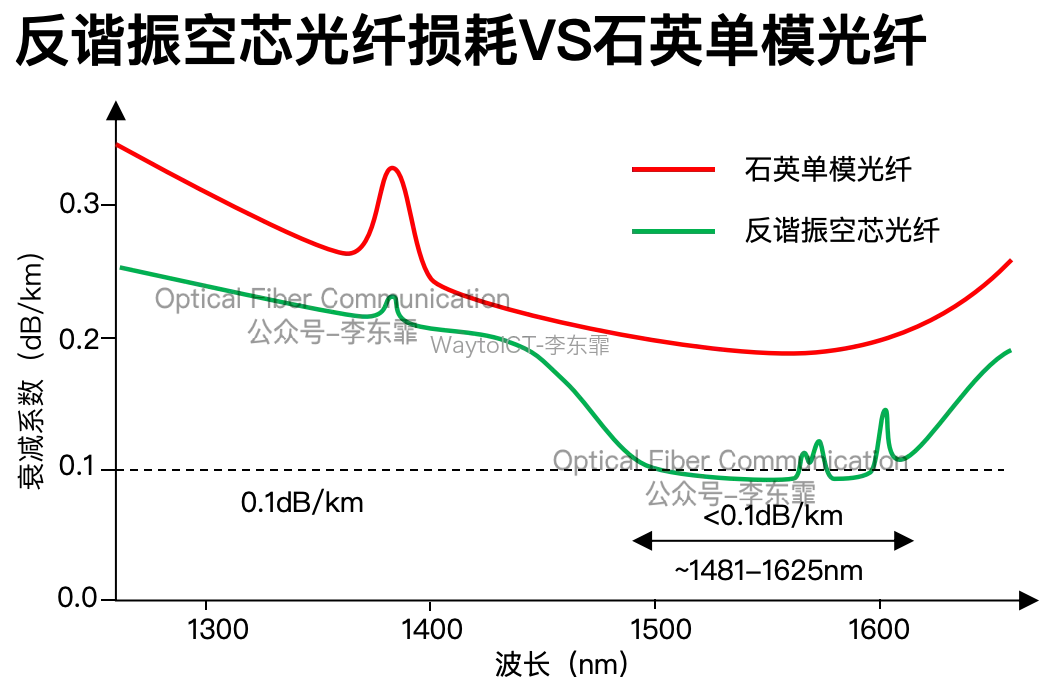
For solid-core fiber, Rayleigh scattering is inversely proportional to the fourth power of wavelength, while infrared absorption loss increases with wavelength. The two meet to form the low-loss window of silica glass near 1550 nm.
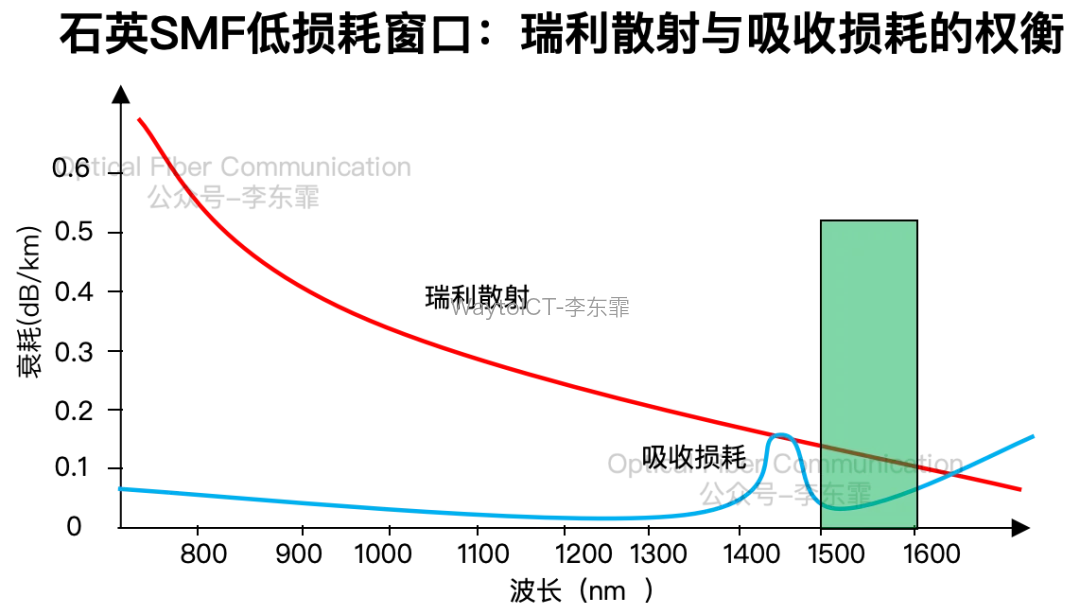
These windows are determined by the properties of the glass material. The C/L band has become the mainstream for long-distance transmission because the EDFA and device ecosystem are mature; the O band has relatively low loss, but is insensitive to distance and is mostly used in short-distance and multimode scenarios.
The theoretical loss floor of high-purity silica solid-core fiber is about 0.14 dB/km (1550-1580 nm). Over the past four decades it has improved only about 30%, already approaching the material limit.
Another constraint is that the Kerr nonlinearity limits the optimal launched power. Beyond the optimum, nonlinear crosstalk rapidly degrades the SNR; the higher the power, the more obvious the SNR degradation.
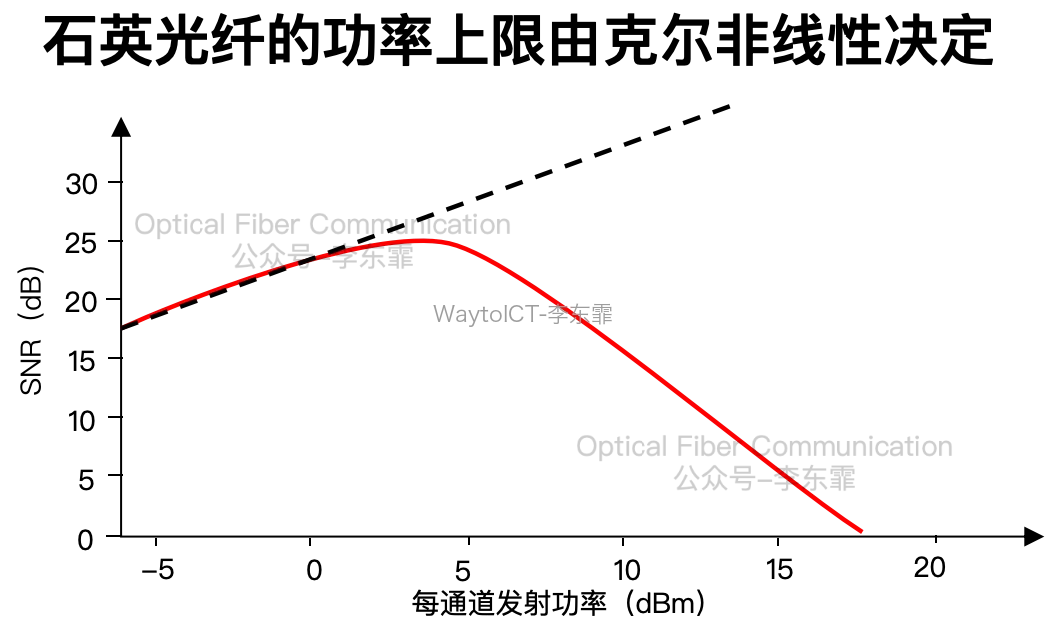
The Kerr effect comes from the third-order nonlinearity of the medium, and the nonlinear refractive index of air is far smaller than that of silica glass. In hollow-core fiber the optical field mainly propagates in air, and the overlap ratio with glass is greatly reduced, so the nonlinearity is extremely low.
The earliest scheme was the PBGF photonic bandgap fiber, which relies on a periodic microstructure cladding to confine light within the air core.
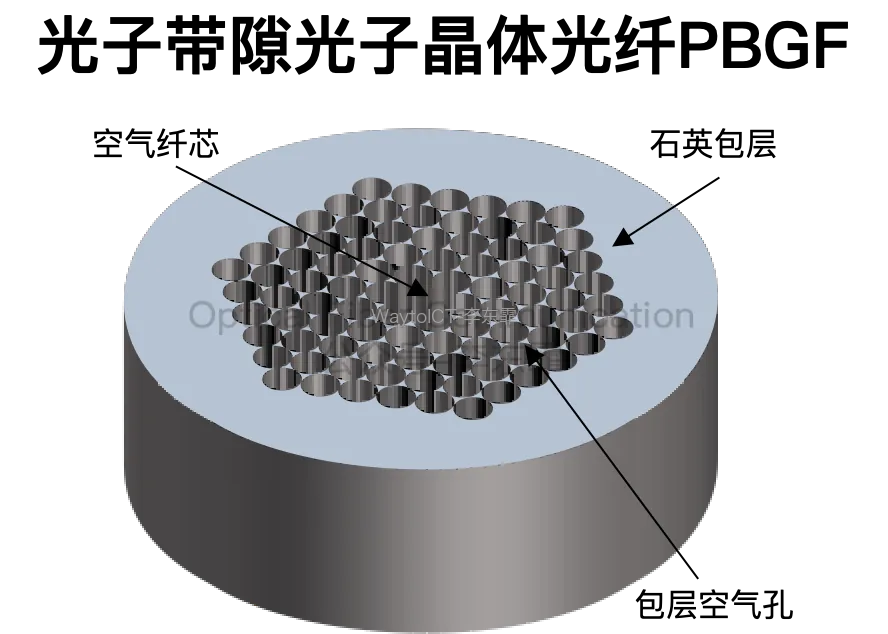
Early research reduced the attenuation from tens of dB/km to 1-2 dB/km, with the landmark result of 1.7 dB/km at 1550 nm. Its significance lies in proving that long-distance light guiding in an air core is feasible, and that the material absorption and nonlinearity brought by glass can theoretically be suppressed.
But PBGF has a narrow operating bandwidth, is sensitive to structural perturbations, with loss mainly from surface scattering, and insufficient mode purity. To achieve practical transmission performance, a different light-guiding mechanism is needed.
Anti-resonant hollow-core fiber is an important turning point. It relies on the anti-resonant reflection of the thin glass membrane around the core to confine the optical field while suppressing mode coupling.
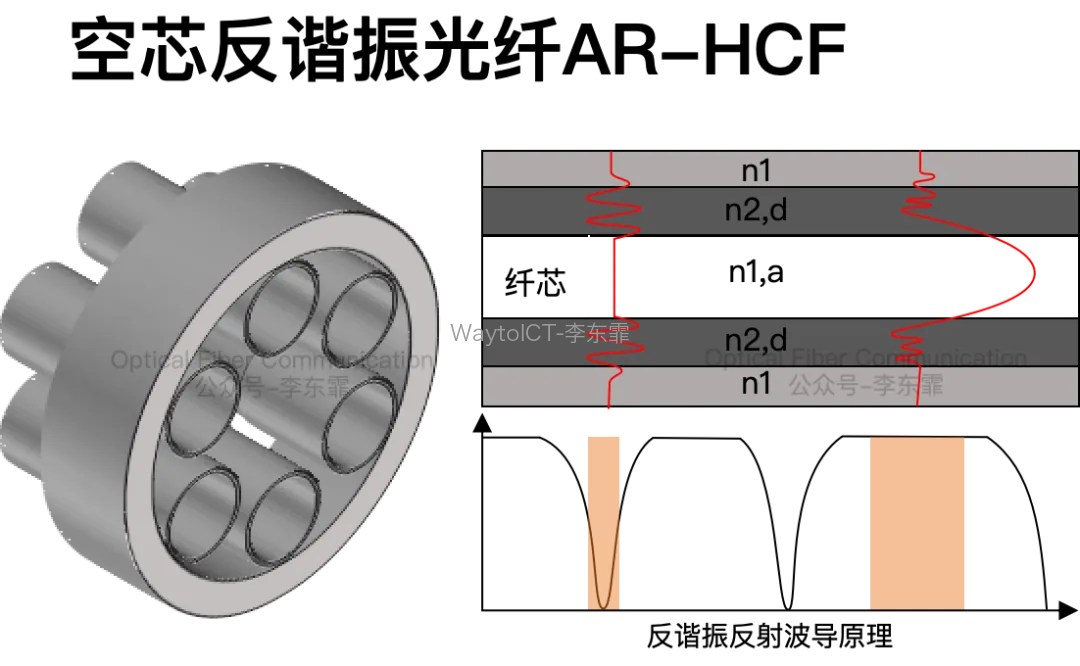
Compared with PBGF, this mechanism significantly reduces the overlap ratio of the optical field with glass, thereby suppressing surface scattering loss.
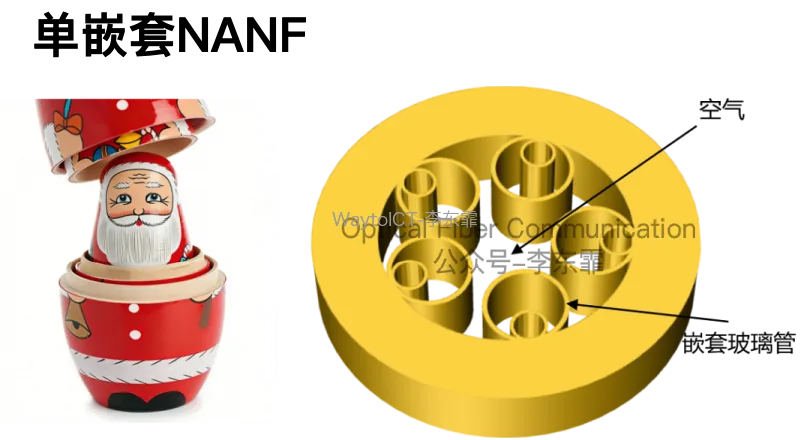
The single-nested NANF design proposed in 2014 introduces nested glass sleeves in the cladding, enhancing light confinement while suppressing higher-order modes. At this time, the main loss mechanisms turn to leakage and microbending.
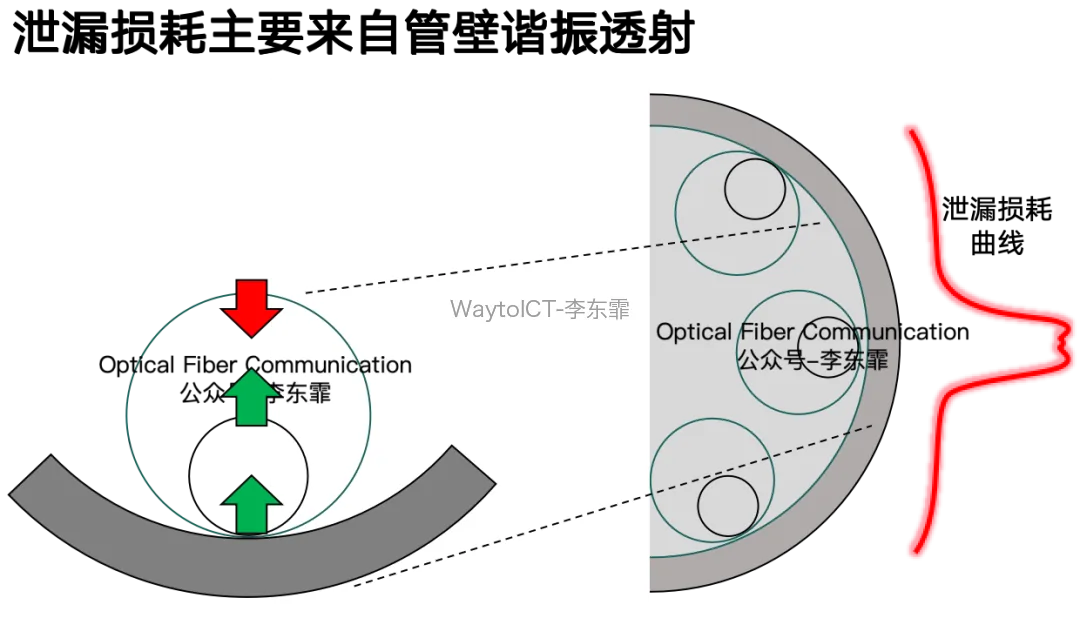
Leakage loss mainly comes from the resonant transmission of the tube wall membrane: after the core light reaches the capillary wall, if the wavelength matches the resonance condition of the tube wall F-P cavity, the light penetrates the tube wall and leaks outward, and the loss curve shows a peak.
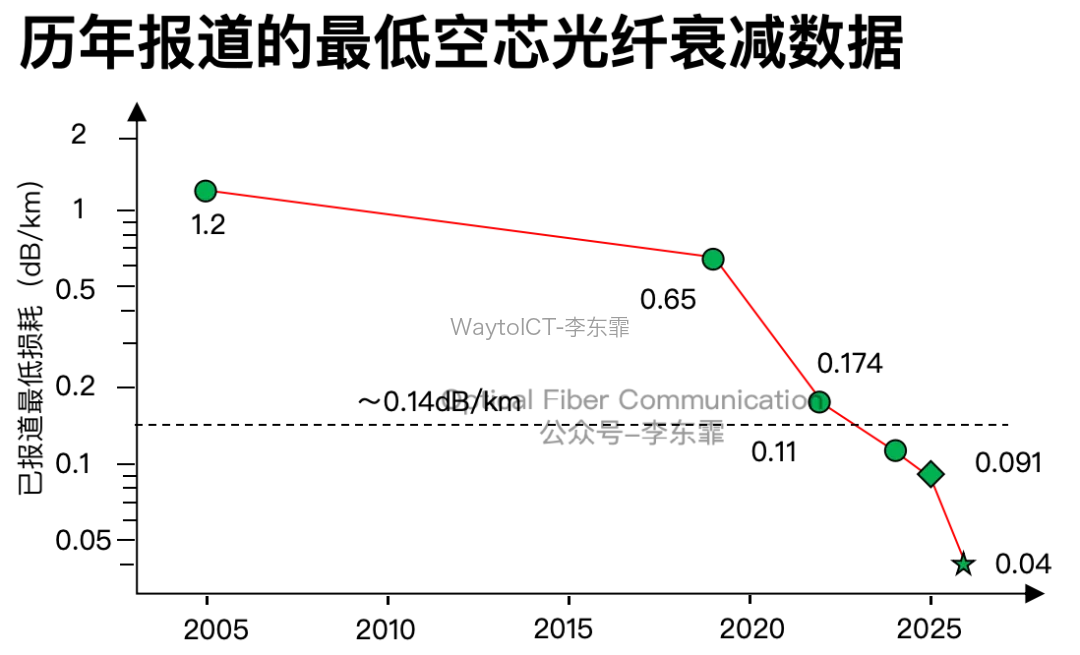
The first-generation low-loss NANF achieved 1.3 dB/km attenuation and completed data transmission verification; subsequent optimization reached 0.65 dB/km in the C+L band.
After 2020, design, manufacturing uniformity, and test methods continued to iterate, and NANF loss dropped to about 0.28 dB/km, approaching the level of traditional single-mode fiber.
Further optimizing the fiber geometry, such as the number and arrangement of sleeves, achieved a record loss of about 0.22 dB/km, while improving higher-order mode suppression, extending the operating spectrum from the communication near-infrared band to visible light.
In 2022, the double-nested anti-resonant nodeless fiber DNANF added one more layer of nested sleeves, further reducing leakage loss, allowing a smaller core, while alleviating the microbending sensitivity problem.
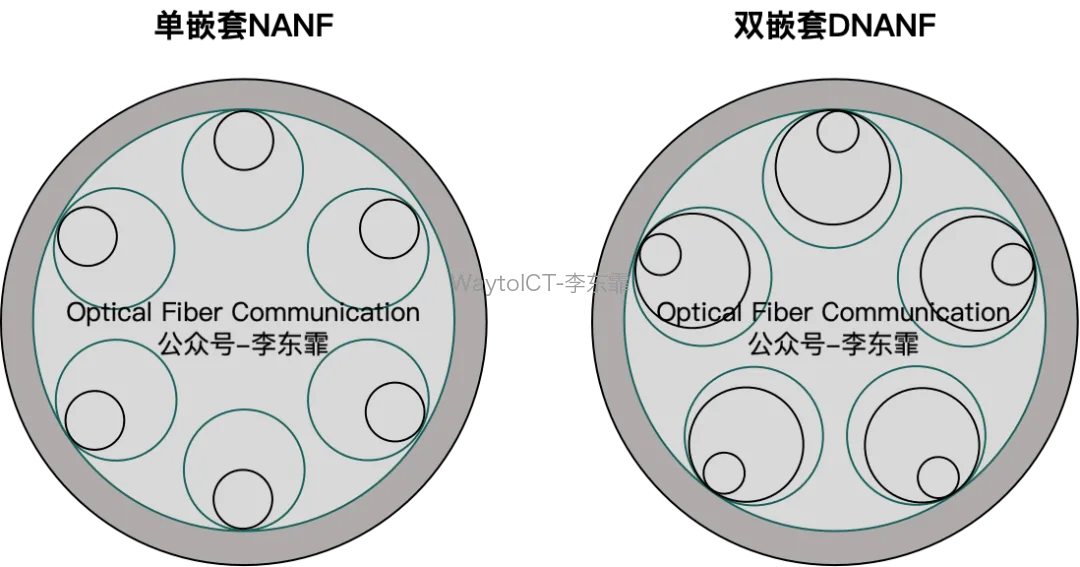
The loss dropped from 0.65 dB/km in the C/L band in 2019 to 0.174 dB/km for the double-nested structure in 2022.
Subsequently, through systematic optimization of geometry and process, DNANF achieved loss below 0.1 dB/km, reaching 0.08 dB/km at 1550 nm, the lowest fiber loss reported at the time.
Analysis shows that surface scattering loss is roughly inversely proportional to the cube of the core diameter, and leakage loss drops faster; enlarging the core can reduce both losses simultaneously, but microbending loss will rise.
Therefore, each wavelength has an optimal core size. According to this model, the optimized DNANF loss can be as low as about 0.04 dB/km, and the theoretical limit may reach about 0.02 dB/km.
At present, the attenuation of hollow-core fiber has broken through the intrinsic loss floor of solid-core fiber.
Let’s draw another schematic comparing the per-channel launch power under nonlinear effects.
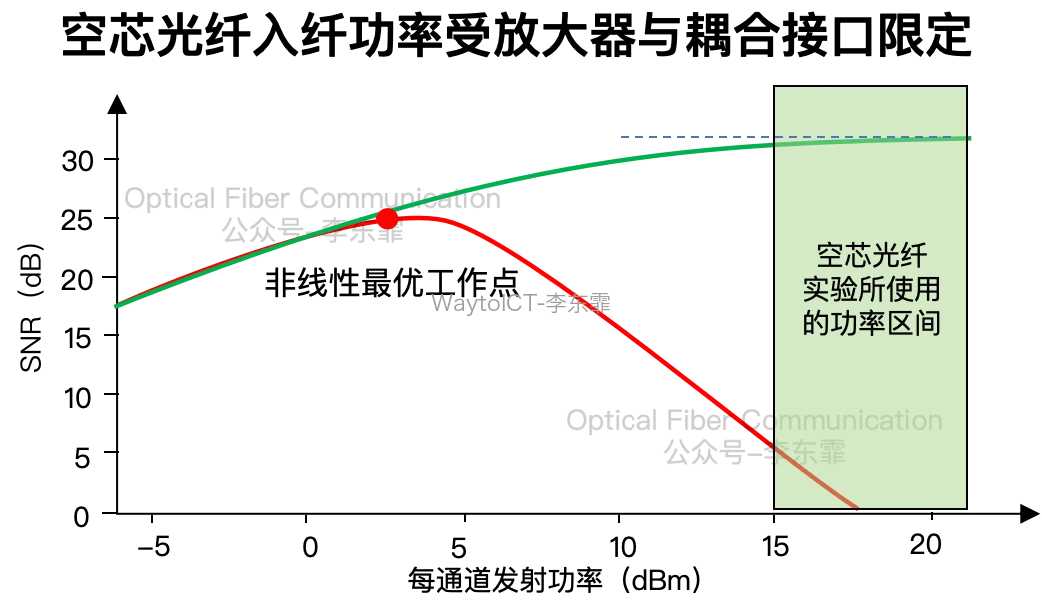
In hollow-core fiber, light propagates in air, so nonlinearity is almost negligible, and the SNR continues to improve with power, with the upper limit mainly constrained by amplifier and coupling interface noise.
Currently, new structures such as gap-sleeve-assisted DNANF have been used to solve manufacturing difficulties and relax structural tolerance, for example “Yangtze Optical Fibre’s ST-HCF Hollow-Core Fiber with Support Tube Structure“.
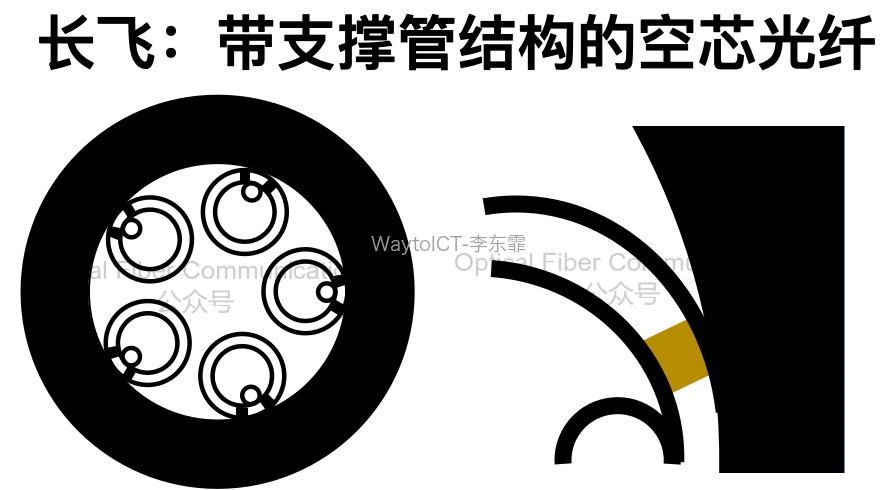
Overall, these advances have basically eliminated the main obstacles that previously hindered the practical application of hollow-core fiber; hollow-core fiber is at a turning point, but not yet mature.
Thanks for reading. Please forgive any inaccuracies!
Extended reading:
POET: High-Power Multi-Wavelength Hybrid Integrated Laser Array for CPO
Huawei: Multi-Wavelength Light Source Technology Evolution and Schemes Supporting C+L Band
Sumitomo: SoCoC Quasi-Flip-Chip Scheme for Dual-Series Differential EML
Coherent: 448G PAM4 InP MZM-SOA Array for CPO
You can add WeChat WaytoICT to be invited to join the Semiconductor & Optical Device Industry Chain Group 2.
Welcome to join our community to obtain high-value technical documents, trend research reports, and various supply-demand business opportunities in the semiconductor chips / optical devices / optical transceivers field.
If you are interested in semiconductors / optical devices / optical transceivers / optical fiber communication, welcome to follow us!
Enjoy this article?
Subscribe to get new optical communication insights delivered to your inbox. Free, unsubscribe anytime.