The VCSEL is an ideal light source for photonic integrated circuits (PIC). However, VCSELs emit perpendicular to the wafer plane, while the PIC lies within the wafer plane. So how can VCSEL light be coupled into the PIC wafer plane?
Currently, there are at least four methods for coupling light from a VCSEL into an in-plane PIC. The first and most direct method is end-to-end coupling, placing the VCSEL at the end of the in-plane waveguide. A spot-size converter is built to reduce the coupling loss between the VCSEL and the in-plane waveguide. The figure below shows end-to-end coupling between a VCSEL and a PIC based on the SOI platform.
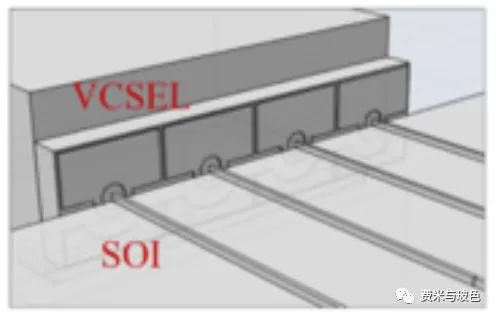
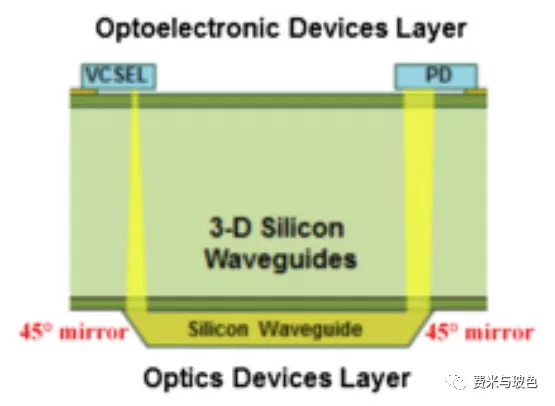
To ensure high coupling efficiency between the VCSEL and the silicon waveguide, a spot-size converter on the PIC side is always used. The second method is to use a 45° micro-reflector to guide vertically incident light from the VCSEL located on the top surface of the waveguide into the in-plane waveguide. The 45° micro-reflector can be fabricated mechanically or by etching, but coupling efficiency is a very critical issue.
The third method is based on grating couplers. A diffraction grating is inserted into the top DBR of a GaAs-based VCSEL to couple light into a horizontal waveguide. This monolithic technique requires epitaxial regrowth. Another more direct method is to etch a surface grating into the top layer of the VCSEL’s top DBR without epitaxial regrowth. This surface grating achieves 40% coupling efficiency.
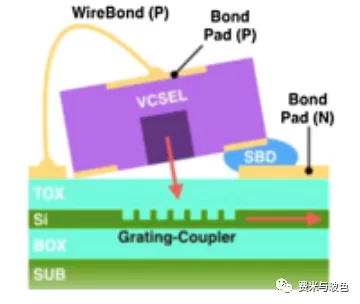
Recently, silicon grating couplers coupled light from VCSELs into waveguides, showing 20 Gbps non-return-to-zero (NRZ) transmission at 1550 nm for the packaged PIC. The fourth method is to use photonic wire bonding to connect the VCSEL to the in-plane waveguide. The emerging photonic wire bonding technique has been used for chip-to-chip interconnect and chip-to-fiber interconnect.
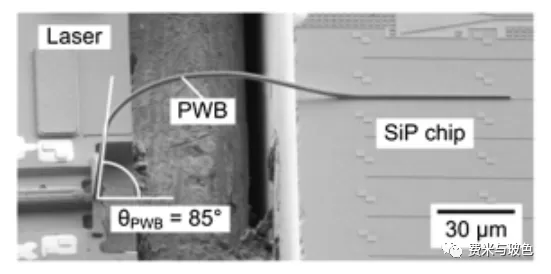
In recent years, hybrid integration of silicon photonic circuits and InP-based horizontal-cavity surface-emitting lasers has been achieved through photonic wire bonding, indicating that photonic wire bonding is a promising method for achieving integration between VCSELs and PICs.
Related Reading
- Maximum Coupling Loss (MCL) and Maximum Path Loss (MPL)
- Silicon Photonics Series 2: What Is a Grating Coupler?
- Is This Wafer-Level Packaging?
Enjoy this article?
Subscribe to get new optical communication insights delivered to your inbox. Free, unsubscribe anytime.