
Semiconductor products can generally be divided into four major categories based on their type: optoelectronic devices, sensor devices, discrete devices, and integrated circuits. Among these, integrated circuits occupy a dominant position in the market size of the semiconductor industry.
Integrated circuits cover several important sub-fields, including analog chips, microprocessor chips, logic chips, and memory chips. In today’s semiconductor market, integrated circuits account for more than 80% of the entire semiconductor market size, and analog chips account for about 15%.
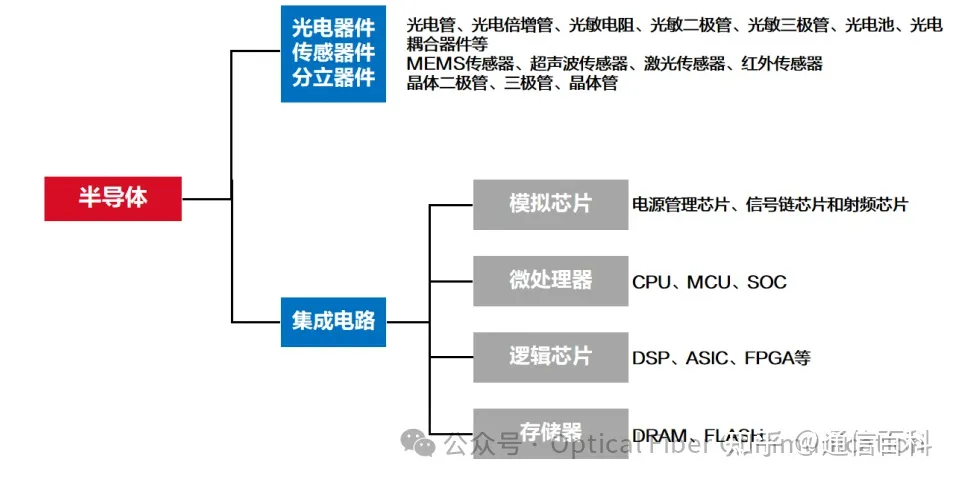
Figure: Semiconductor classification
What functions do analog chips have?
Analog signals use a series of continuously varying electromagnetic waves or voltage signals to represent information content, with amplitude values having a continuous characteristic; digital signals use discrete signals to represent information content, with amplitude values having an equally-spaced discrete characteristic. Analog chips are specially designed to capture, process, and transmit continuous analog signals, such as sound, temperature, and light, unlike the discreteness of digital signals. Analog chips can perform extensive processing on real-time-varying voltage and current signals, including signal amplification, filtering, and modulation, providing key support for the acquisition, processing, and transmission of analog signals. Analog circuits are the basic building blocks of analog chips, mainly composed of components such as resistors, capacitors, transistors, and diodes. These basic components form the building blocks of analog circuits and are combined and configured according to the requirements of specific applications to perform various signal-processing and control tasks.
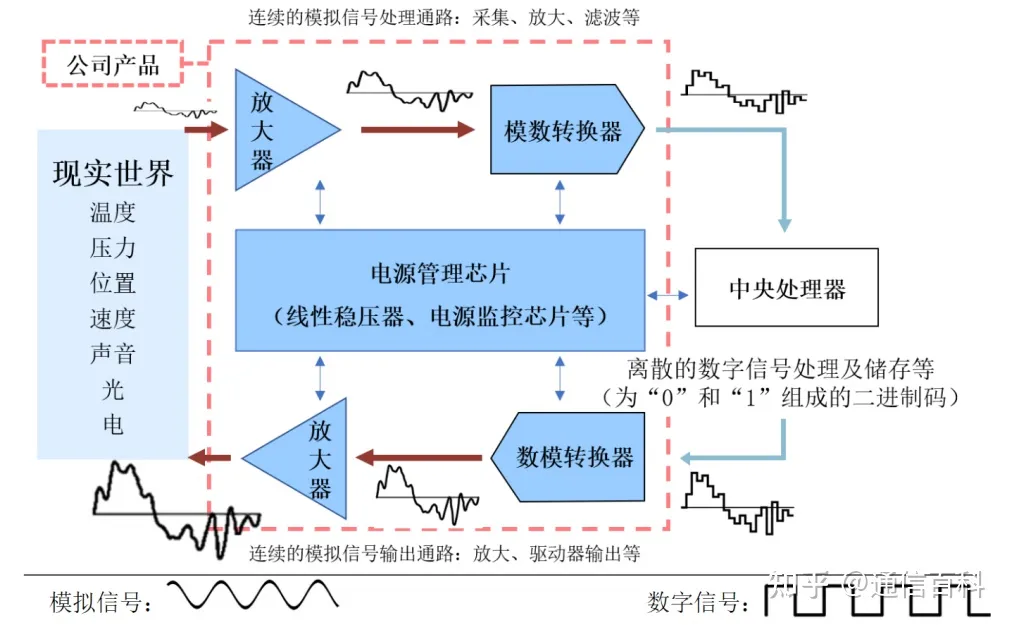
Figure: Schematic of analog chip product functions
How do analog chips differ from digital chips?
Analog chips and digital chips differ in principle, process, product life cycle, process node, price, and application. Analog chips have a long update cycle and stable design; digital chips update quickly and follow Moore’s Law. Analog chips place more emphasis on the accumulation of technical experience, require high precision, and have a high entry barrier; digital chips have lower precision requirements and focus on bit count. In addition, analog chips have a long learning curve, with a learning curve as high as 10-15 years, while digital chips are shorter and have higher process-node requirements. Analog chips are highly customizable and have low substitutability; digital chips are highly versatile and interchangeable. Analog chips pursue diversity; digital chips pursue mass production. Analog chip prices are relatively stable; digital chip prices are prone to fluctuation.
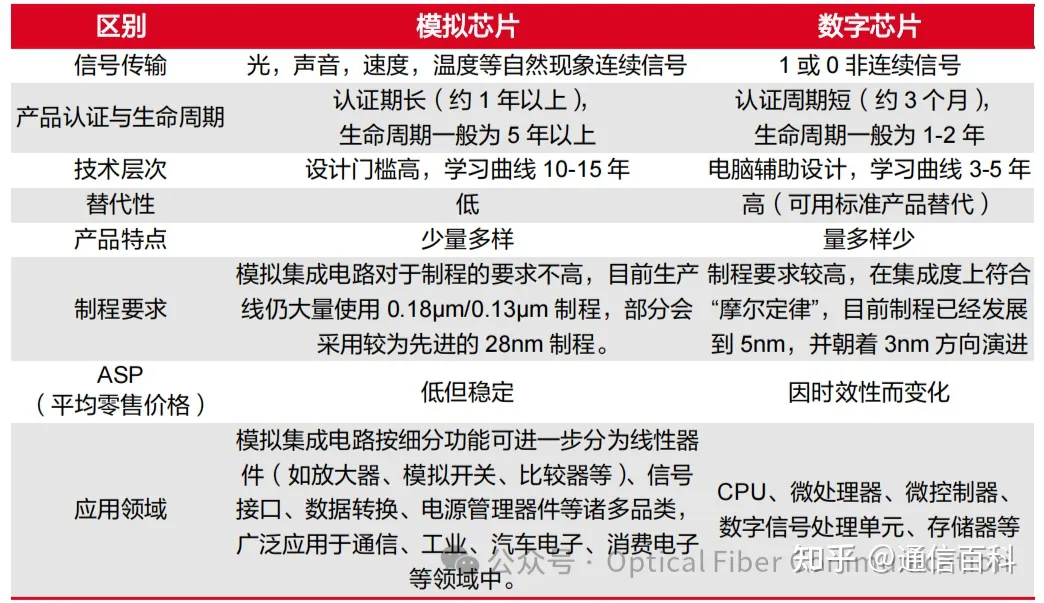
However, in many cases a product does not contain only analog chips or only digital chips; usually they work together simultaneously to complete a guiding task, and mixed-signal chips are also a common type we see. For example, in the following fields:
- Sensor field
Analog chips are used in various sensor products, such as temperature sensors, pressure sensors, and acceleration sensors, to complete precise analog-signal acquisition and processing tasks, while digital chips are used for subsequent digital-interface output.
- Audio field
Analog chips handle the analog-to-digital conversion, amplification, and filtering of the audio front end, while digital chips focus on the digital signal processing and storage of audio.
- Display field
Analog chips are used in the scanning and amplification circuits of CRT displays, while digital chips are responsible for the control and digital signal processing of LCD/LED displays.
- Measurement instrument field
Analog chips are responsible for front-end analog circuits such as signal amplification, filtering, and sample-and-hold to ensure measurement accuracy; while digital chips mainly perform subsequent digital processing and display tasks.
- In the communications field
Analog chips are used for analog signal-processing work such as modulation, demodulation, and amplification in radio, while digital chips focus on the encoding, decoding, and equalization of digital signals. In the control field, analog chips are mainly used for error correction of sensor feedback, while digital chips are used to execute the main control logic and algorithms.
—–-End——
Related Reading
- How to Couple VCSEL Light into the PIC Wafer Plane?
- What Is Strained-Layer Epitaxy?
- 2024 Semiconductor Industry Research Report – Automotive-Grade Chips
Enjoy this article?
Subscribe to get new optical communication insights delivered to your inbox. Free, unsubscribe anytime.