This year’s OFC conference once again put the new advances in optical communication technology in the global spotlight. Among them, the significant progress of 100G ZR pluggable devices attracted particular attention, and it is expected to play an increasingly important role in edge computing.
The hollow-core fiber that we have been paying close attention to was also reported during the conference. The hollow-core fiber technology jointly developed by Lumensity/Microsoft and the University of Southampton achieved a major breakthrough, with loss as low as 0.11 dB/km, far superior to conventional fiber. At the same time, KDDI’s achievement of 16.4 THz bandwidth in the O-band and a transmission distance exceeding 80.4 km also drew widespread attention across the industry.

Hollow-core fiber
Particularly eye-catching is the construction of AI infrastructure, especially the optical connectivity technology between chips and fibers. Although optical interconnect holds great potential in bandwidth, energy efficiency, latency, and transmission distance, how to establish a reliable and economical optical transmission method remains a challenge facing the industry.
Lessengers demonstrated an innovative technology that uses the direct optical wiring (DOW) polymer process to connect fibers directly to chips, showing a connection array containing 64 fibers. It is said to be designed specifically for AI/ML workloads in hyperscale data centers.
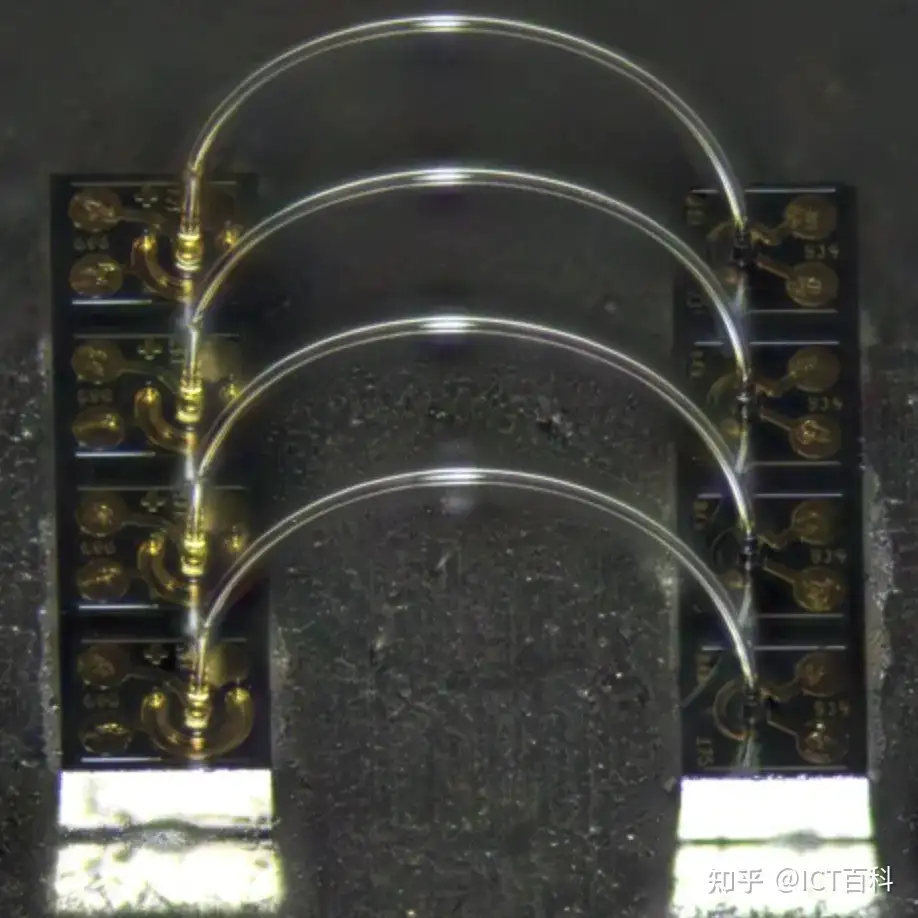
DOW technology demonstration
The Czech company SQS, Lightmatter, Intel, and Ayar Labs also showcased their latest achievements in optical connectivity and silicon photonics.
The core of the conference was the future outlook of optical transmission technology, including carrying data at the terabit-per-second level on a single optical wavelength and shrinking coherent optics to a size suitable for router ports.
Meanwhile, data centers are receiving increasing attention, and optical interconnect technology is expected to become a hot topic at future shows. Breakthroughs in long-haul transmission technologies such as 800ZR pluggables reflect the industry’s demand for unified standards, compatible transceivers, and the urgency to improve metro and long-haul network capabilities.
Although competition in optical network technology is fierce and progress is steady, six vendors have made significant advances at terabit transmission speeds. Among them, 800ZR pluggable technology became the industry focus. These advances not only solve capacity and distance issues but also provide new directions for the development of optical transmission networks.
Innovation in transmission networks will always revolve around the fundamental question of how to provide greater capacity over long distances. With the emergence of new fibers and more transmission bands, coherent technology will continue to upgrade, and transmission rates are expected to exceed 1.6T.
But these advances must solve not only capacity and distance issues but also a key bottleneck in optical transmission networks: cost. It is hoped that through continuous innovation and close cooperation, the optical communication industry can break through technical boundaries and provide more efficient and economical solutions for future communication and AI computing needs.
Welcome to join our community, which keeps updating for 800+ days!

Related Reading
- Optical Interconnect Toward 3.2T: Some Issues and Thoughts on 425G/lane
- Fudan University: The Latest Progress in MicroLED Optical Interconnect Technology
- Marvell: Views on Optical Interconnect Selection, NPO Opportunities, and Challenges for AI Clusters
Enjoy this article?
Subscribe to get new optical communication insights delivered to your inbox. Free, unsubscribe anytime.