Related reading (Marvell series): Some Views on Marvell’s Scale Up/Out + the 102.4T CPO Switch | Marvell: The Technical Evolution and Product Roadmap of 1.6T Coherent Optics
At CIOE 2026, Marvell shared its views on the Scale-up and Scale-out optical interconnection trends.
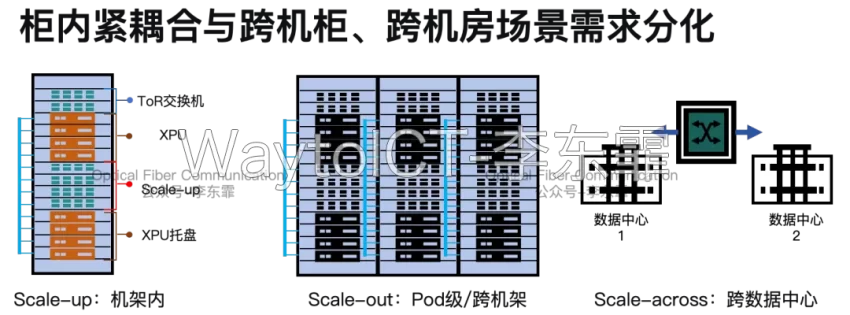
Marvell believes that Scale-up, Scale-out, and Scale-across in AI computing clusters have completely different requirements for bandwidth, latency, and topology, and cannot use the same set of schemes.
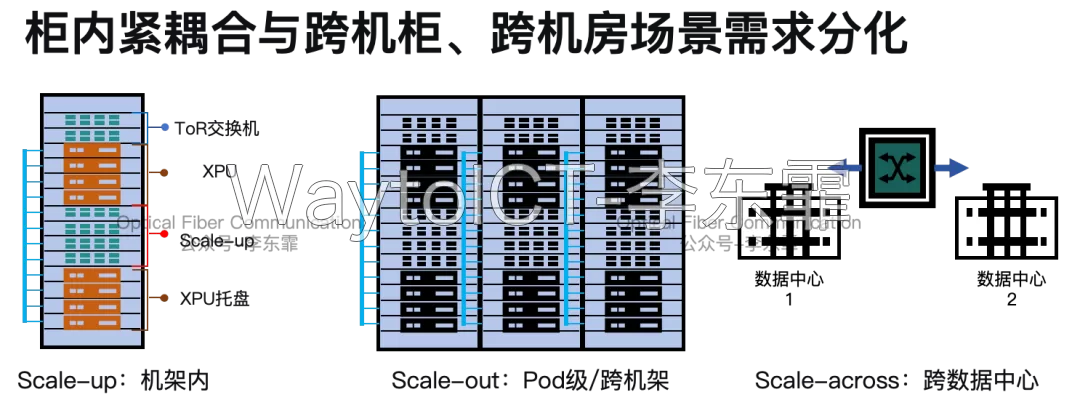
In-rack Scale-up pursues extreme performance and low latency, and whether to use copper cable or optical fiber depends on actual needs.
The latency requirement of cross-rack pod-level Scale-out is relaxed to the millisecond level. Because the distance exceeds the rack and electrical signal attenuation is severe, optical interconnection schemes must be used.
Marvell compared several optical interconnection schemes. As optical devices move closer to the switch ASIC, electrical channel loss gradually decreases. Compared with traditional pluggable optical modules, NPO and CPO halve power consumption, but maintainability also decreases.
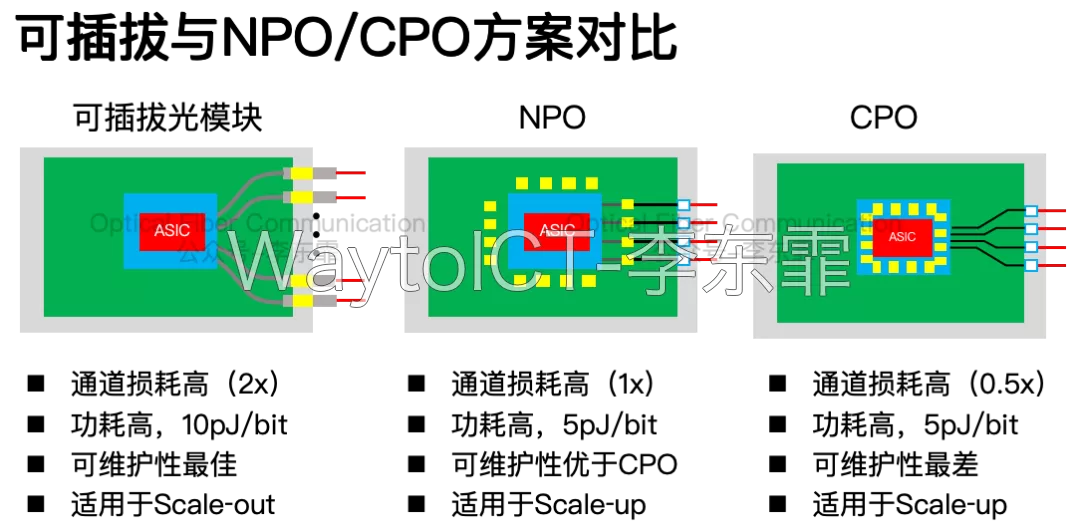
From a technical positioning perspective, NPO is a transitional scheme, and CPO is the final form, both mainly targeting Scale-up tightly-coupled supernode applications.
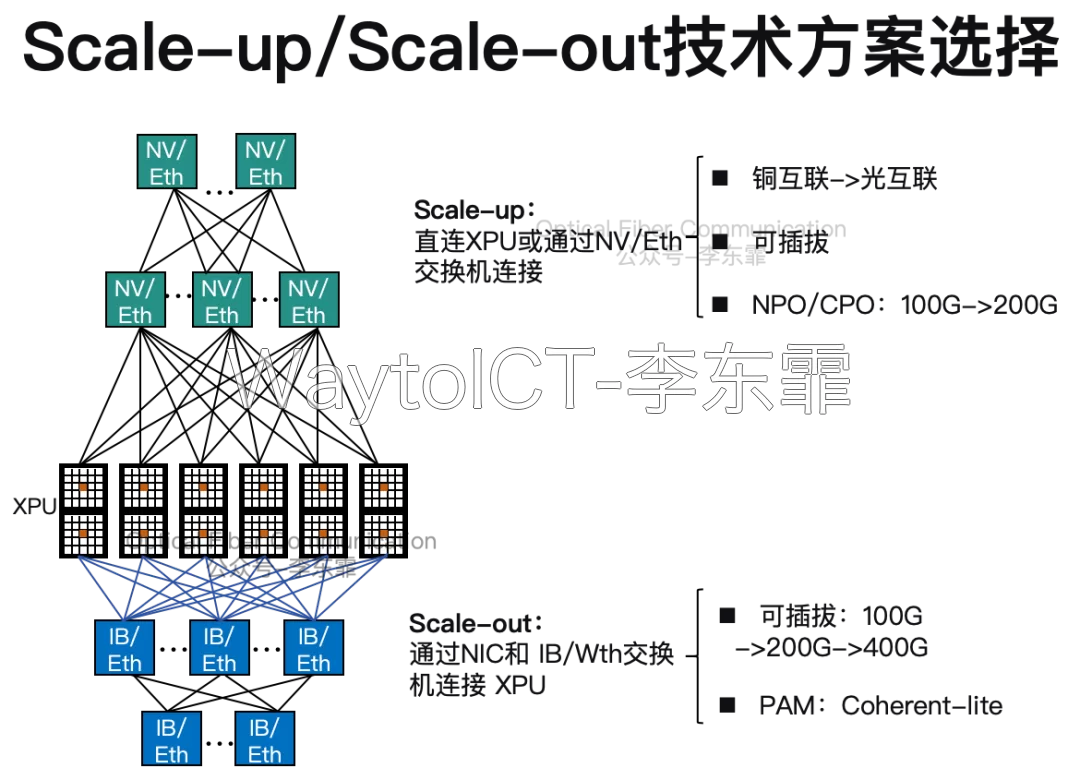
However, Marvell believes that the pluggable scheme is still the mainstream of Scale-out. As the single-channel rate increases, the PAM4 transmission distance becomes shorter and shorter.
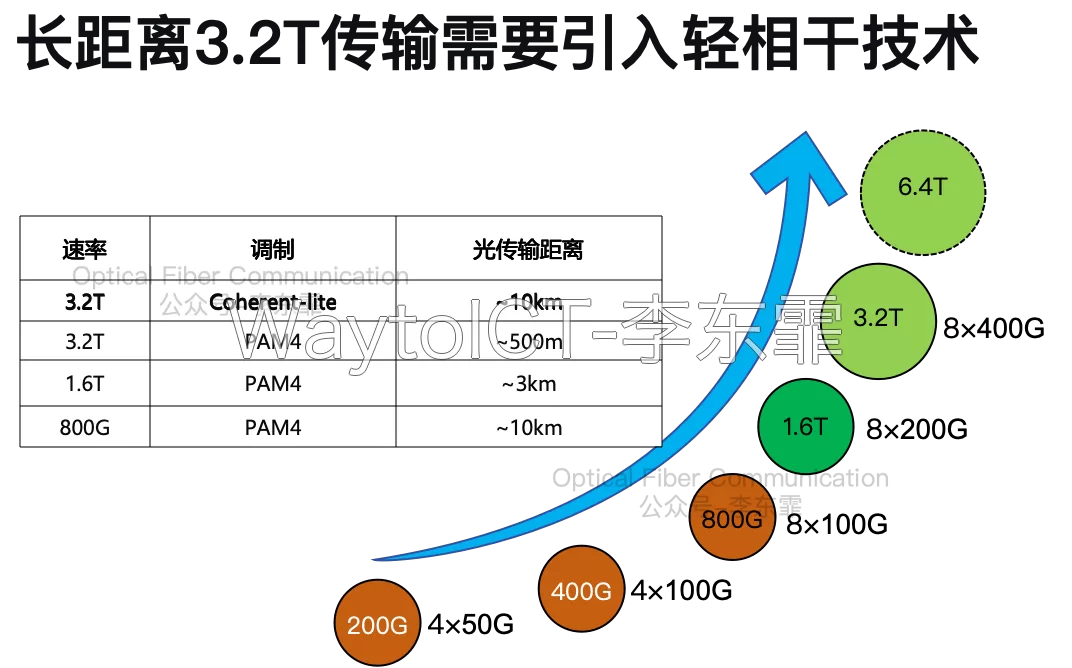
In the 800G era, this problem did not exist, but by 1.6T, the PAM4 transmission distance is only about 2-3 km, so the 2-10 km campus interconnection scenario needs to introduce Coherent-lite lightweight coherent technology.
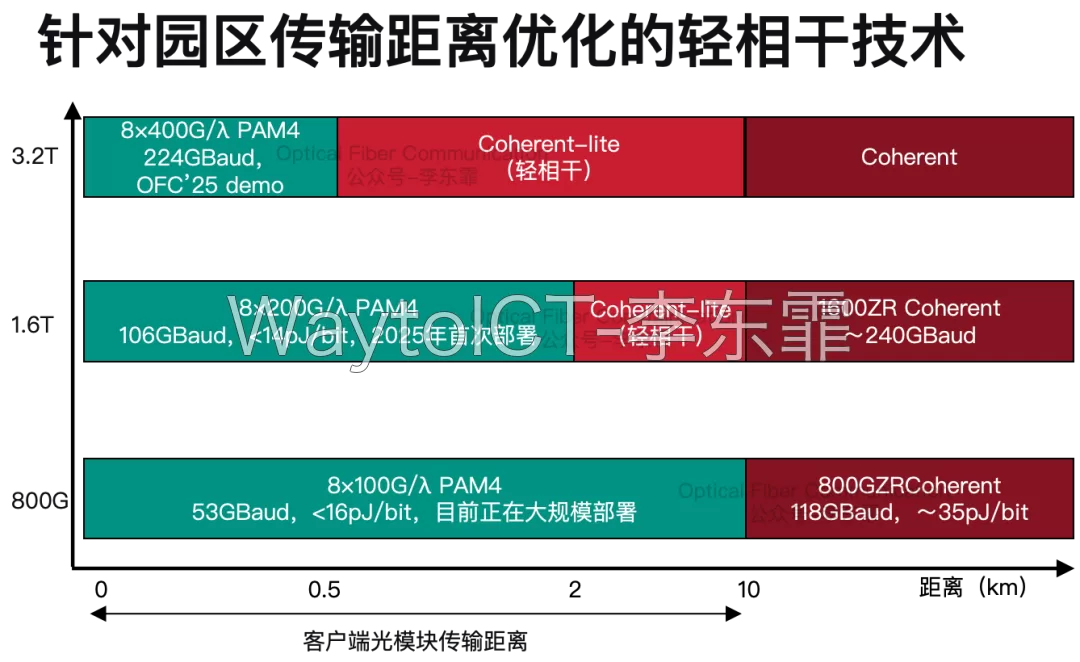
In particular, after entering 3.2T, Scale-out short distance can continue to use the PAM4 FRO scheme, but the campus medium-long distance must switch to the Coherent-lite lightweight coherent scheme to restore long-distance transmission capability.
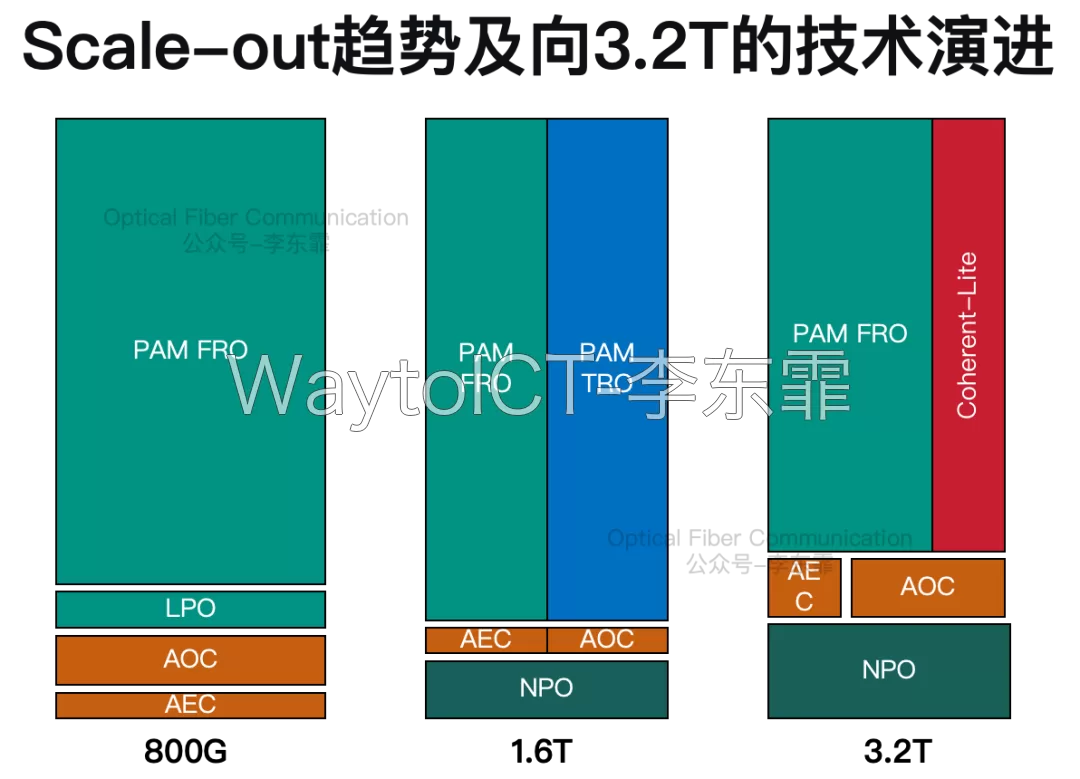
In addition, in the 1.6T/3.2T era, the number of XPUs in multiple racks will reach thousands. The space, heat dissipation, and power supply of the switch front panel reach physical limits, so it is also necessary to introduce the NPO scheme on the switch side.
It can be said that the NPO scheme can be partially applied to Scale-out scenarios. At the same time, Scale-up is extending from racks to rack rows, covering the high-density short-distance interconnection needs of Scale-out across racks.
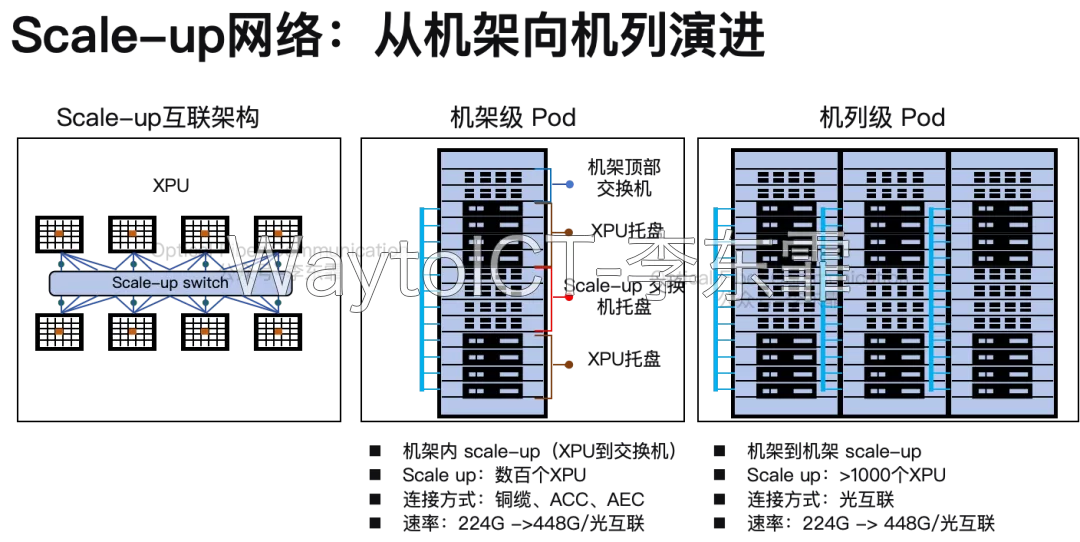
However, Marvell believes that in short-distance scenarios, copper cable is still the mainstream scheme by virtue of low power consumption and low cost.
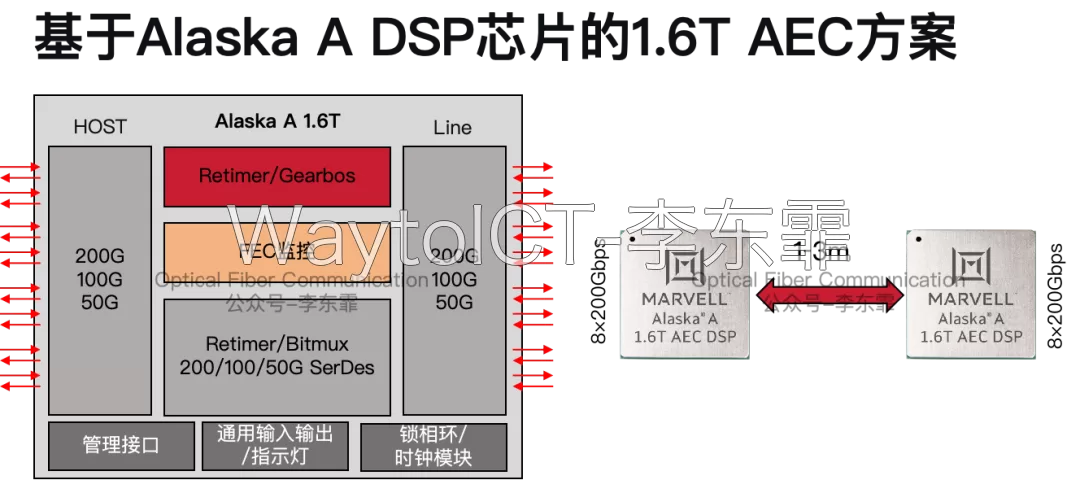
For example, in June 2025, Marvell released the Alaska® A 1.6T PAM4 DSP scheme for AEC active copper cables, designed specifically for short-distance in-rack connections, supporting 1-3 m transmission distance (learn more).
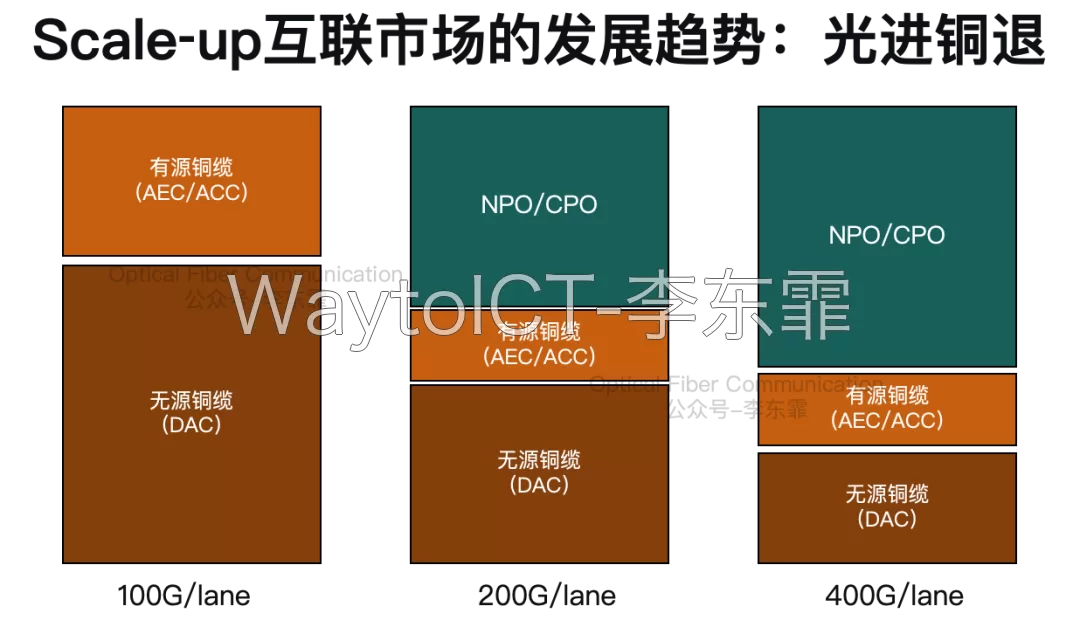
However, when the single-channel rate reaches 200G/400G, the PCB routing loss of electrical signals from the switch ASIC to the front-panel pluggable module increases sharply.
At this point, NPO/CPO schemes are needed to shorten the high-speed electrical signal routing distance, thereby reducing power consumption and latency.
Currently, the shipments of 800G and 1.6T FRO/TRO/LPO products have reached tens of millions. The industrial chain can optimize TRO and LPO based on the existing verified TIA and Driver, or even develop NPO/CPO optical engines by simply removing the DSP.
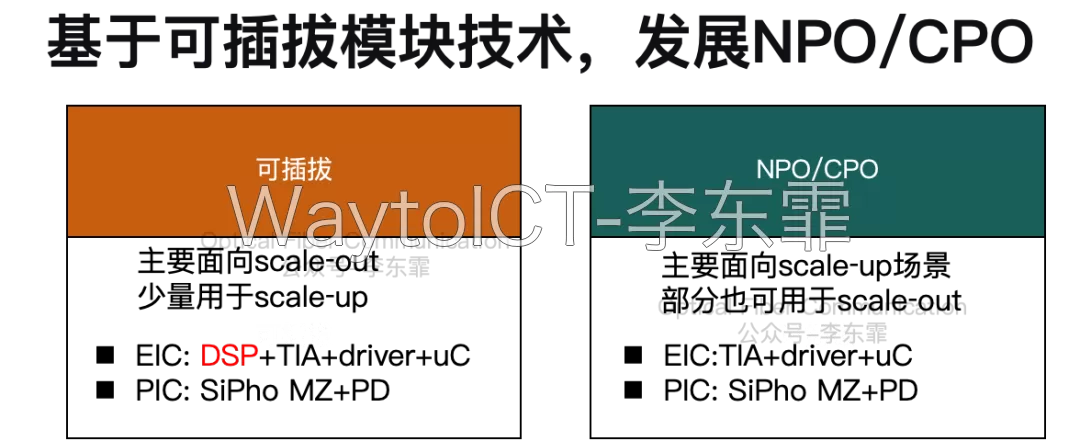
Marvell believes that, on the one hand, the massive XPU interconnection requires the low latency and low power consumption of NPO/CPO to solve the interconnection pain points inside computing cabinets.
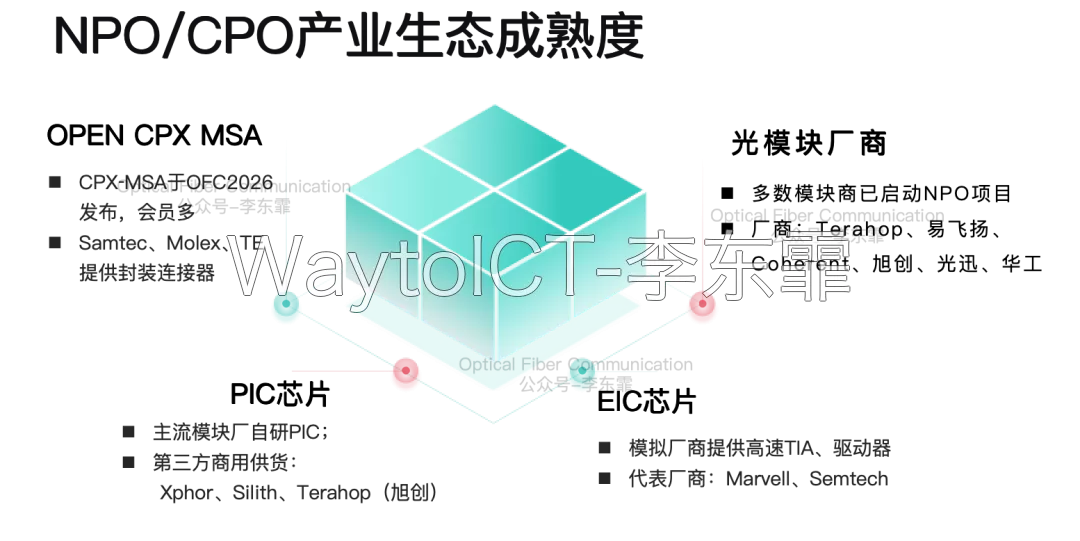
On the other hand, the industry already has the foundation for implementation. The single-channel 100G LPO scheme has been verified and deployed, and the single-channel 200G NPO near-packaging performance has also been verified well.
Moreover, the entire supply chain of silicon photonics PIC, TIA, Driver, high-speed connectors, and substrates is gradually maturing, and NPO already has the conditions for implementation.
But just like the ending of the article Alibaba Cloud: 3.2T NPO Technology Progress and Roadmap described, Marvell also believes that NPO faces some problems that need to be solved urgently.
For example, high-precision optical alignment and fiber coupling, as the number of channels increases, is clearly more difficult than traditional pluggable modules.
High-density packaging brings yield risks. Once a single channel fails, it directly affects the entire optical engine assembly, and the packaging process is far more complex than ordinary optical modules.
In addition, reliability and thermal management are also challenges. Adjacent to the high-heat switch chip, local temperature rise will cause laser wavelength drift, power consumption increase, and shortened lifespan, significantly increasing the difficulty of the overall heat dissipation architecture design.
Finally, there is the maintainability problem. The NPO optical engine is deployed inside the line card board, and even if made into a CPX socket-type detachable version, on-site replacement is still very inconvenient.
Thanks for reading.
Please forgive any inaccuracies!
The compilation report on Optical Chips, Optical Devices, and Optical Transceivers (OFC2026), printed in color and bound in A4, consists of two volumes totaling about 525 pages, about 200,000 characters. If you need it, welcome to contact us to order, at a favorable price!
WeChat contact: WaytoICT
Further Reading
- HGGenuine: 3.2T Scheme Progress and the NPO Evolution Roadmap
- What Is OCS? The Working Principle, MEMS Technology, and Industry Landscape of Optical Switches
- What Is EML? The Working Principle, Applications, and Evolution of Electro-Absorption Modulated Lasers (EML)
Enjoy this article?
Subscribe to get new optical communication insights delivered to your inbox. Free, unsubscribe anytime.