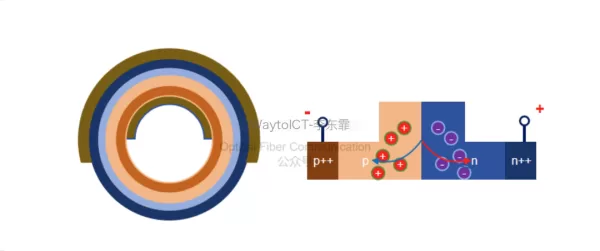
This article is part of the WaytoICT paid reading column. The technical analysis and accompanying schematics require a ¥9.9 payment to unlock! Since this process relies on the movement of majority carriers, its response speed is usually faster than the injection type and is more suitable for high-speed applications. The third type is the carrier-accumulation…
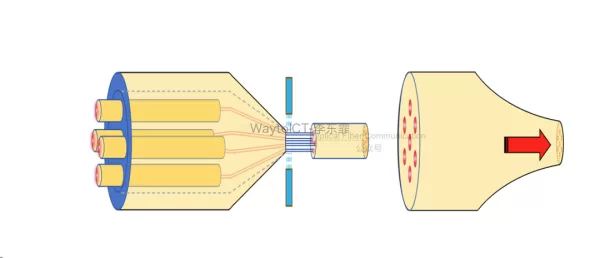
Hengtong Optic-Electric: Transitional Fan-In/Fan-Out Scheme for Efficient Single-Core to Multi-Core Fiber Connection
This is a WaytoICT paid-reading column. The full technical analysis and accompanying schematics require a ¥9.9 payment to unlock! The benefit of multi-core fiber is straightforward: it transmits multiple independent signals in parallel within a shared cladding, with a theoretical capacity N times that of single-core fiber, where N is the number of cores. The…
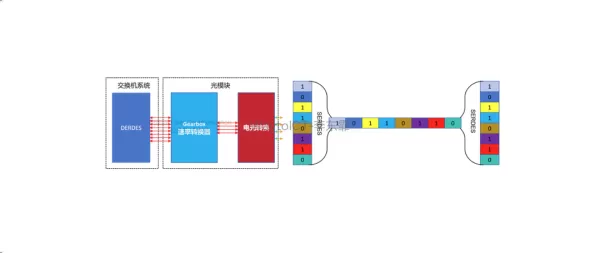
Gearbox and Reverse Gearbox in Optical Modules, and Their Difference from SerDes
This is a WaytoICT paid-reading column. The full technical analysis and accompanying schematics require a ¥9.9 payment to unlock! The so-called “mismatch between rate and channel count” means that the electrical and optical rates develop inconsistently — the rate of a single electrical channel and a single optical channel differ and cannot be aligned directly….
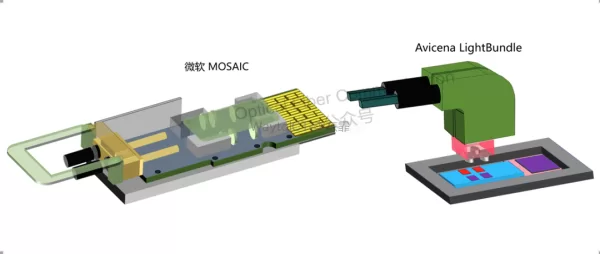
MicroLED and the Was Architecture: MicroLED Schemes from Microsoft and Avicena
This is a WaytoICT paid-reading column. The full technical analysis and accompanying schematics require a ¥9.9 payment to unlock! This difference originates from their different light-emission mechanisms: LED emits light through carrier spontaneous emission, while LD relies on stimulated emission and the feedback amplification of an optical resonant cavity. In the current choice of optical…