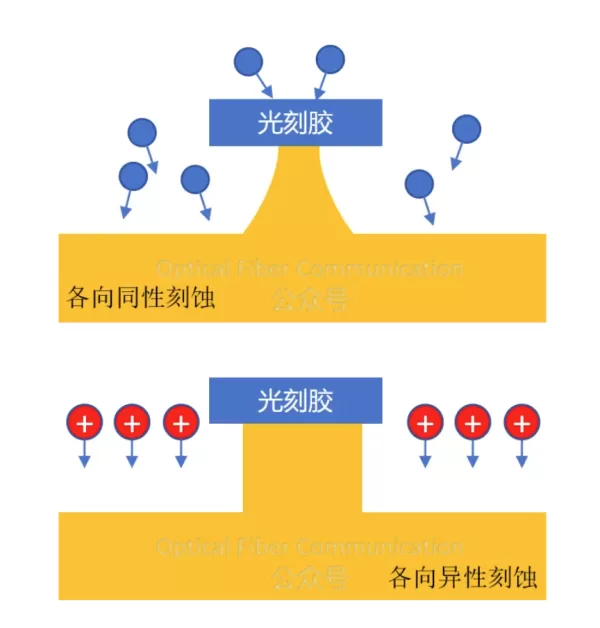
Reactive Ion Etching, also called RIE, is a process in semiconductor manufacturing for etching structures into thin films. RIE can perform both isotropic etching (etching roughly equally in all directions) and anisotropic etching (mainly etching downward), as shown in the schematic below. It has this capability because RIE combines chemical reactions and physical bombardment. Let…
Technology
MEMS and OCS
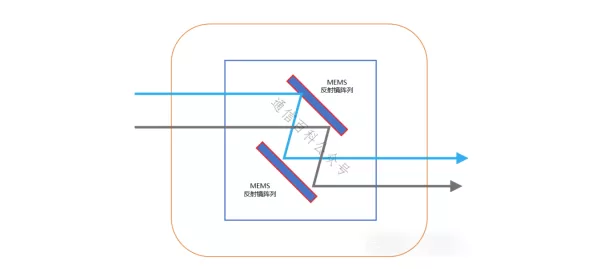
The urgent demand for scalable interconnect in AI data centers is driving a key breakthrough in optical circuit switching (OCS) technology based on micro-electromechanical systems (MEMS). How does OCS optical circuit switching work? In an OCS system, an optical signal enters from one port and encounters a “matrix” covered with micro-mirrors. These mirrors are extremely…
The O-Band and Wavelength Selection
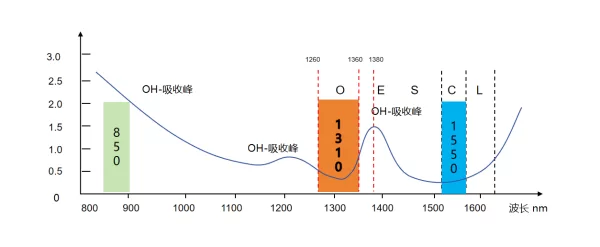
The O-band, that is, the spectral range of 1260-1360 nm, was defined in the mid-1970s, a period when the power loss of optical fiber within the O-band was the lowest. As for its short-wavelength boundary of 1260 nm, we have already discussed it in the previous article “Why 850 nm and 1260 nm?“. Its long-wavelength…
Why 850nm and 1260nm?
When electromagnetic waves propagate in different media, their characteristics are often highly selective. This is particularly evident in silica optical fiber. Although the electromagnetic spectrum is extremely broad, including various radiations from microwaves to gamma rays, the optical band in which optical fiber communication can actually work effectively is limited to a very narrow range…