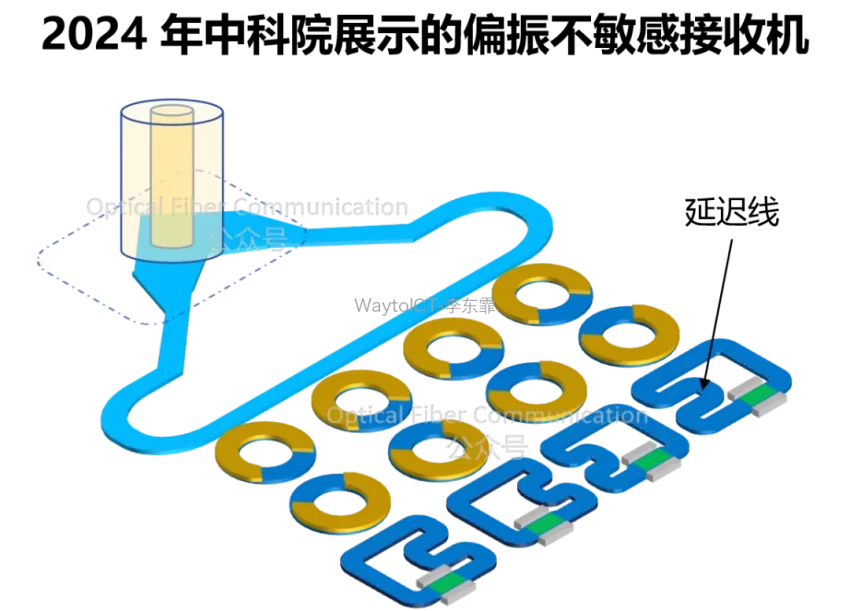
In the article “Passive and Active Polarization Management, Intel’s Silicon Photonics Polarization Diversity Receiving Scheme“, I mentioned the receiver structure demonstrated by the Chinese Academy of Sciences. There was a “delay line” marked in it, and a reader privately asked me about its working principle. Let me explain it in detail here. The function of…
TSMC: Thoughts and Views on Advanced Technology Design Approaches
Sharing some views from TSMC’s Dr. Lu on advanced technology design approaches. Dr. Lu joined TSMC in 2000 and has headed the Design and Technology Platform division since 2018. Working with the process R&D team, he developed design-technology co-optimization (DTCO). We have discussed DTCO in a previous article, “Acacia/Cisco: DTCO and STCO Co-Optimization Approaches for…
MACOM: DRV/TIA Technology Evolution and Trade-offs for 2.4T/3.2T
The electrical chips in high-speed optical modules fall into two major categories: analog and digital. On the analog side are the driver chip (DRV) on the transmit side and the transimpedance amplifier (TIA) on the receive side, responsible for amplifying and converting the optical-electrical signals. On the digital side, the DSP does the heavy lifting:…
Basics: NPO Multimode and Single-Mode Solutions and Packaging Layout
Alibaba Cloud: Progress and roadmap of 3.2T NPO technology Tencent: Progress and large-scale deployment of 3.2T NPO near-packaged solutions STMicroelectronics: Progress of the silicon photonics process platform supporting NPO/CPO Eoptolink: NPO optical engine based on VCSEL Recently I have written quite a few articles on NPO, so today let me briefly sort out the knowledge…